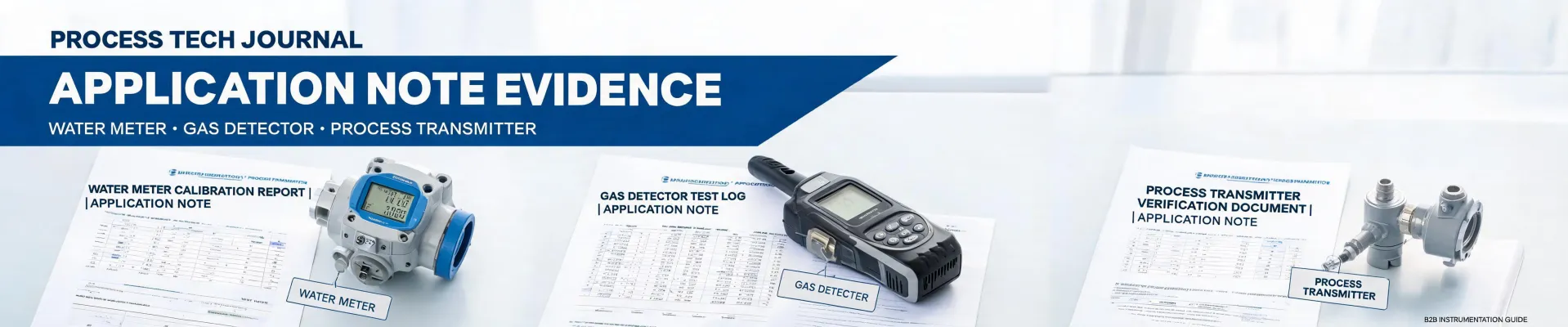
When an Itron Intelis Water Meter Reading Failed the Test: A Quality Inspector's Story
2026-08-24 by Marcus Feld
That morning started like any other in the quality lab. Coffee in hand, I pulled up the test schedule for the day. It was a big one: the first batch of Itron Intelis water meters for a utility client—50,000 units total, with 5,000 in the initial lot. I'm the quality and brand compliance manager here. I review every metering product before it reaches customers—roughly 200 items per quarter. I've rejected about 7% of first deliveries this year due to calibration drift, bad soldering, or missing documentation.
The plan was straightforward. We'd run the standard battery of tests: visual inspection, dimensional checks, and a flow accuracy test. For the accuracy test, we use a calibrated rig that measures itron water meter reading at multiple flow rates. The tolerance is ±0.5% for the Intelis series, if I remember correctly. These meters are known for reliability—but that doesn't mean every batch is perfect.
The First Couple of Hours
We started sampling. Every meter looked good on the outside. We weighed them on a precision scale—I won't get into the weighing scale price, but it wasn't cheap, and that's a procurement story for another day. The weights were within spec, which suggested the materials and casting were consistent. Then my technician, Dave, pulled out his 233 multimeter and started testing the circuit boards for continuity. All good so far.
But when we moved to the flow rig, something felt off. The first few meters were fine: within 0.2% of the reference. Then we hit meter #27. Its reading was off by 1.2%—more than double the allowed tolerance. We re-ran it, same result. Then #28, #29, #30—all with the same offset.
We looked at each other. A pattern like that doesn't happen by accident. We went back to the meter itself, feeling the seams, checking the register wheel for any visual obstruction. Nothing looked wrong. My brain started racing through possible causes: temperature compensation, sensor alignment, firmware glitch? I'm not a firmware engineer, so I couldn't rule that out. But something deeper was going on.
The Unexpected Pattern
Dave scratched his head and said, “Maybe the vision system is misreading the register? I mean, isn't that camera using a Sony sensor? Does Cognex use Sony sensors—my buddy said something about that once.”
I had to pause. Actually, I laughed. “I'm not a sensor engineer, so I can't speak to whether Cognex uses Sony sensors. What I can tell you from a quality perspective is—our reference meter is traceable to NIST, and its calibration is solid. So if the vision system sees a misalignment, the issue is probably real.” I didn't know the answer, and I wasn't going to pretend. Better to focus on the data.
We dug further. The failed meters all came from the same production week, according to the serial numbers. We opened up a few and found it: a batch of capacitors that didn't match the approved parts list. The resistance values were just outside spec, causing the signal processing to drift. It was subtle—easily missed by a quick glance.
I called the supplier, and their first response was the classic one: “It's within industry standards.” I'm sure it was, for a generic meter. But we're not generic. We specified a certain component quality for a reason. We rejected the batch. The supplier had to rework all 5,000 meters at their cost, and they had to fly in a quality engineer to oversee the fix. That cost them time, and it cost us a week.
Looking back, I should have insisted on component-level testing during incoming inspection. At the time, we trusted the supplier's certificate of compliance—which proved insufficient. But hindsight is a luxury. Given what we knew then, our decision was reasonable.
So, What Did We Learn?
This experience reinforced something I've been saying for years: professional boundaries aren't a weakness. When Dave asked about Cognex and Sony, I could have made something up. I could have said, “I think so,” and we'd have wasted an hour chasing a ghost. Instead, I admitted my limit and redirected to what I know—test protocols and data interpretation.
I'd rather work with a specialist who knows their limits than a generalist who overpromises.
My experience is based on utility-scale orders of 10,000+ units. If you're handling smaller custom batches, your risk profile is different. But the principle holds: the best quality gatekeeper isn't the person who knows everything about every component. It's the person who knows when to say, “I don't know—let's find the expert.”
We updated our incoming inspection to include component sampling on high-risk parts. It added a day to the lead time, but it also caught this problem before it reached the field. In a utility network, a 1.2% drift could mean thousands of gallons of unaccounted water. That's not a risk I'm willing to take.
So, yes—it took eight days to get the replacement batch through, and the initial delivery slipped by a week. The client saw the report, understood the cause, and appreciated the transparency. In the end, the weighing scale price or the cost of a better multimeter doesn't matter much compared to the cost of a failed product in the field. The real investment is in the process, the attention, and the willingness to call in someone who knows the bits we don't.

Marcus Feld
Marcus Feld is an electrical test and measurement analyst specializing in multimeters, oscilloscopes, clamp meters, insulation testers, spectrum analyzers, and data loggers. He applies IEC 61010-2-030 and IEC 61010-031 concepts while examining measurement category, bandwidth, true-RMS response, input loading, and stated uncertainty. His work helps maintenance engineers and test teams choose safe instruments with performance suited to the signals and environments they actually measure.
Leave a Reply