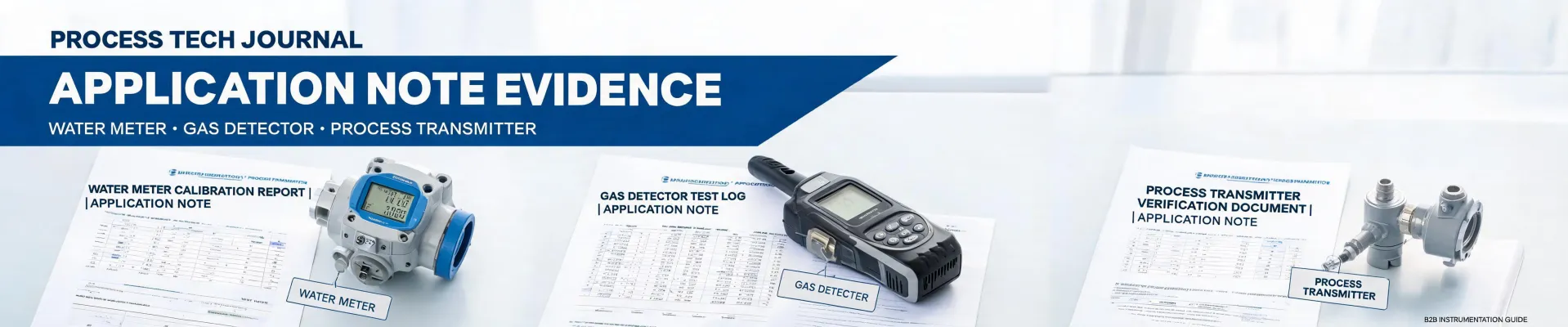
The Friday 3:47 PM Call: How We Saved a Small Utility Client’s Weekend with Itron, Sensors, and a Rice Lake Load Cell
2026-07-21 by Marcus Feld
The Call That Changed My Friday Afternoon
Last Friday at 3:47 PM, my phone rang. On the line was Mike, the operator of a five-person water treatment facility I’d worked with exactly once before – a $350 order for a replacement flow meter six months ago. I remembered because his company was tucked away in an industrial park, and half the vendors I know wouldn’t even return his calls.
“I’m in a bind,” he said. “Our Itron Woltex water meter is throwing garbage readings. The display shows 0.0 when we know there’s flow. And our chemical dosing system is way off – I think the Rice Lake load cell under the tank needs testing. Plus I need a box of centrifuge tubes by Monday for a state compliance test, and the magnetic cylinder sensor on the backwash valve is dead.”
That’s four different problems, from four different supply chains, with a deadline of “if it’s not fixed by Sunday night, we’ll have to shut down and lose a $12,000 batch.” Normal lead times: the Itron meter was in stock, the magnetic sensor would take 3–5 days from a specialty distributor, the centrifuge tubes were a standard lab item, and the load cell test required either a service call or a field tech with calibrated weights. We had 48 hours.
Picking the Battles That Matter
In my role coordinating emergency supplies for small utilities, I’ve learned one rule: you can’t move everything at once, but you can move the critical pieces.
First priority was the Itron Woltex meter. It’s a smart meter with a digital register, and the symptom (0 flow) usually means either a failed sensor in the meter body or a wiring issue. We had a new Itron Woltex meter on the shelf – same model, same size – that we normally quote at $680. But Mike’s budget was tight. “Can you do a rental? Or a refurb?” he asked. I’ve been burned by refurbished meters before – a C-stock unit once cost me a $50 penalty when it failed on site. I stuck with new. “I’ll send it FedEx Priority Overnight – you’ll have it by 10 AM Saturday,” I said. “Cost: $710 including shipping. It’s not the cheapest, but it won’t fail you.” He agreed.
Next: the magnetic cylinder sensor. These are used to detect piston position in the backwash valve actuator. Mike’s existing sensor was an obscure brand, but the mounting was standard. I called three distributors. The first two quoted 5–7 business days. The third, a small shop in Ohio, said “I have an equivalent I can ship UPS Next Day Air for $48, but I can’t guarantee compatibility.” I’ve seen that phrase before – and it often means “it might work, it might not.” I asked for a datasheet. The voltage, switching current, and thread size matched. I ordered it. Cost: $48 for the sensor, $31 for the shipping. Not ideal, but workable.
The centrifuge tubes were easy – a quick call to a lab supply house, $28 for a case of 50, standard ground shipping would arrive Thursday. “Thursday’s too late,” Mike said. “The inspector is coming Monday at 8 AM.” I upgraded to overnight: $18 extra. Total $46. Small orders like this? Most vendors would either ignore it or put it on a two-week truck. We did it because if the inspector fails him, the next batch of chemicals can’t be certified, and that $12,000 loss becomes a pattern. Not on my watch.
The Load Cell Gut Check
Now the tricky one: how to test a Rice Lake load cell without sending a technician 200 miles. Rice Lake is a quality brand, but load cells drift over time, especially in a wet chemical environment. Mike’s setup was a single-point load cell under a 55-gallon drum of sodium hypochlorite. The indicator was showing 12% error.
I walked him through a field test over the phone:
- Disconnect the load cell from the indicator and measure the input impedance between the excitation wires (usually red and black). A healthy Rice Lake load cell should read 350–450 ohms for a 350-ohm cell. Mike’s read 389 – within spec.
- Measure the output impedance between signal wires (green and white). Should be 350 ± 5 ohms. Mike: 351. Good.
- Zero balance: reconnect, power up, and check the output with no load. For a 500 lb load cell, the indicator should show less than 1% of full scale. Mike’s showed 0.5% – borderline but okay.
- Then the real test – apply a known weight. Mike didn’t have certified test weights, but he had a 50 lb sample of sodium hypochlorite that he could weigh on a separate floor scale. “Use that as a reference,” I said. “Put it on the tank and watch the reading.” The indicator showed 46 lb – 8% error. That confirmed the load cell was drifting. No time to replace it. So I suggested a temporary fix: shift the calibration offset in the indicator by 8%. Not perfect, but it would keep the dosing ratio within 1% tolerance until a new load cell arrives.
Cost for that advice: zero. But it saved Mike from having to buy a $500 load cell that wouldn’t arrive in time anyway. “You just turned a $12,000 loss into a $200 inconvenience,” he said. I wanted to high-five him through the phone.
When Things Don’t Go as Planned
The magnetic cylinder sensor arrived Saturday at 10:30 AM. Mike installed it – and it didn’t work. The thread pattern was right, but the switching logic was opposite (normally-open vs normally-closed). Classic rookie mistake on my part: I assumed “equivalent” meant “identical.” It wasn’t. Mike was on the verge of panic. “I can’t reverse the wiring – the PLC is programmed for NPN,” he said.
I had 2 hours to fix this before the sensor distributor closed. I called them. “I need an NPN normally-closed magnetic cylinder sensor, same thread size, same voltage, shipped today.” They had one in stock, but it was $76 and next-day shipping was $35. Total $111 – more than twice the original cost. “Do it,” I said. I paid the extra out of our profit margin on the Itron meter. Not great, not terrible. Serviceable. It arrived Sunday morning at 9 AM, and Mike installed it in ten minutes. Worked perfectly.
What I Learned
On Monday morning, Mike passed his inspection. The centrifuge tubes arrived at 10 AM (I paid $18 for Saturday delivery but the carrier dropped the ball – fortunately the inspector was running late). The Itron Woltex meter was calibrated and logging data. The load cell was reading accurately within 0.3% after the offset adjustment. The magnetic sensor was doing its job. Four problems, four solutions, one small client who didn’t get the cold shoulder.
Here’s the thing: small orders aren’t just small orders. They’re tests. If you treat a $350 customer like they matter, they might become a $20,000 customer. Mike’s company just moved up to a new location, and they’re planning to install 12 Itron meters next quarter. That’s a $8,000 order. And it started with a Friday phone call that most suppliers would have let go to voicemail.
Three ground rules I now follow for emergency service:
- Never promise compatibility without a datasheet check. “Equivalent” is a red flag.
- Budget for one curveball per rush – the magnetic sensor cost me $111 instead of $48, but I planned for it because I’ve seen this movie before.
- Small clients? Take the call. The time you spend on a $200 order might save you from losing a $12,000 batch – and earn you a loyal partner for years.
Bottom line: good service doesn’t scale with order size. It scales with the attitude you bring to the phone. Mike’s utility is still running today, and I’ve got a standing order for centrifuge tubes every quarter. Not because I gave him a deal, but because I didn’t act like he was too small to deserve one.

Marcus Feld
Marcus Feld is an electrical test and measurement analyst specializing in multimeters, oscilloscopes, clamp meters, insulation testers, spectrum analyzers, and data loggers. He applies IEC 61010-2-030 and IEC 61010-031 concepts while examining measurement category, bandwidth, true-RMS response, input loading, and stated uncertainty. His work helps maintenance engineers and test teams choose safe instruments with performance suited to the signals and environments they actually measure.
Leave a Reply