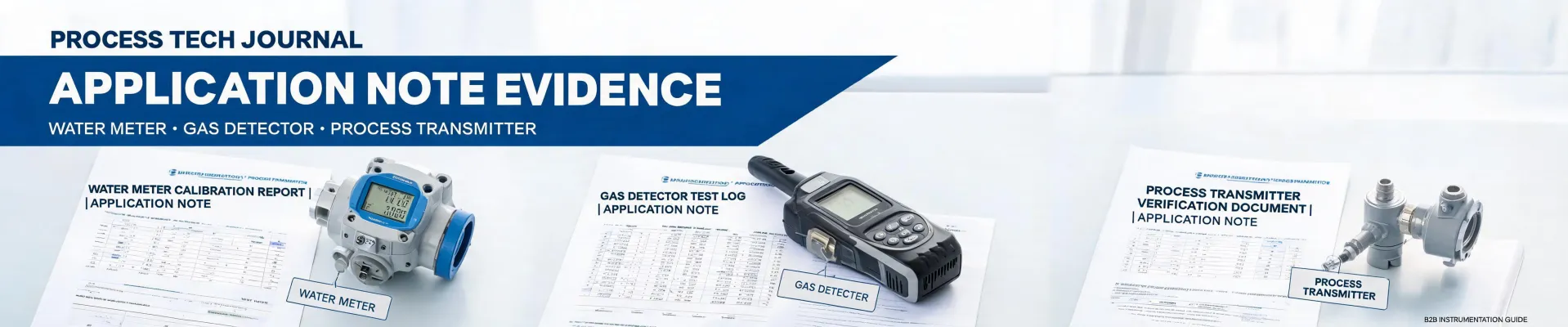
Itron Water Meter, Multimeter, or Repeater Pipette: Choosing the Right Precision Tool When It's Urgent
2026-08-06 by Marcus Feld
There's no universal answer to “which meter should I buy?” It depends on what you're actually measuring. Water flow, electrical signals, and liquid volumes are three different worlds, and mixing them up is expensive.
I say that as someone who coordinates equipment for utilities and industrial facilities. I don't get called when there's time to compare specs calmly. I get called when someone realizes the wrong meter was ordered, or a supplier just backed out, or a client suddenly needs an extra unit for a compliance check. The first thing I ask isn't “what's your budget?” It's “what are you reading, and when do you need to be live?”
So here's my field guide, split by scenario. It won't give you one neat answer, but it will help you find the right one before the deadline does.
The equipment itself might work fine in an ideal world. But if it doesn't fit your existing workflow, the deadline slips no matter how fast the shipping is.
Scenario 1: You Need an Itron Water Meter for a Utility Installation
If your search history includes “itron water meter catalogue,” you're probably not shopping for a bench instrument. You're planning a meter install or replacement, and you need something that meets utility specs and actually fits into your existing system.
Don't let the search results lead you straight to the cheapest option. Start with the pipe size, the expected flow range, and the reading method that feeds into your billing or monitoring system. Itron water meter reading can be a pulse output, an encoded register, or a wireless endpoint. They are not interchangeable. If you order a meter with a pulse output when your system expects encoded data, you'll be back on the phone within a week—or worse, after installation.
I almost learned this the hard way. A client needed a replacement after a well contractor “upgraded” the control panel without checking the existing meter protocol. I knew I should pull up the existing spec before trusting the contractor's model number, but I thought, “what are the odds?” The odds caught up with us when the new meter showed zero reads on the dashboard. The fix cost us a programming visit and a weekend of overtime.
So, when you're reading the itron water meter catalogue, check the communication module before you check anything else. Then look at the flow range. The right meter is the one that speaks to your system and stays within its accuracy band at the actual flow rate you're measuring.
Also pay attention to the minimum flow rate. A meter that starts registering only at two gallons per minute will miss the overnight trickle that happens in most distribution systems. That's not an instrument problem—it's an application problem, and it will show up on the client's invoice as a mystery loss.
The meter you install is the meter your customer sees on their bill. If it under-reads overnight or drops out of the network, the first thing they lose is trust. It doesn't matter how good the price was.
A specific case: in March 2024, a client called at 4pm needing a replacement meter for a regulatory check the next morning. Normal lead time from our usual supplier was about three weeks—or rather, two days if we used the regional distributor we had on speed dial. We paid a 40% expediting fee on top of the base price, but we saved the inspection. The alternative would have been rescheduling and a potential $12,000 penalty. That's when I stopped trusting the “cheapest by Friday” approach.
Granted, this is more work than sending a purchase order to the first distributor. But it's the difference between a two-day install and a two-month headache.
Scenario 2: You're Looking at a Digital Multimeter, Specifically the 115 RMS Reviews
If someone is searching “115 rms digital multimeter reviews,” they're usually an electrician or a technician replacing a worn-out meter. The “rms” matters more than most hobbyists realize. True RMS multimeters can read non-sinusoidal signals accurately, like those found on variable frequency drives and modern electronic loads. An average-sensing meter will give you a reading, but it will be wrong in those situations.
Review scores should be the last thing you check. A multimeter might have earned five stars because it survived being dropped fifty feet, but that doesn't tell you whether its CAT III rating covers your switchgear. Before you buy, look for the voltage rating, the safety category, and whether the stated accuracy is enough for the job. If you work around high-energy equipment, safety category matters more than how nice the display is.
And don't assume every true RMS meter handles distorted waveforms the same way. Some are better than others at low-frequency variable frequency drive signals. If you test motors regularly, look for a bandwidth rating in the spec sheet, not just a “true RMS” label.
To be fair, the 115 rms digital multimeter reviews are generally strong, and it is a solid compact field meter. But it's not automatically the right pick for everyone. If you need data logging or a higher CAT rating, you'll need to look elsewhere. Trust the spec sheet, not the star rating. And if a product page claims something like “accurate to ±1%” without publishing the full spec, treat that as a warning. Per FTC guidelines (ftc.gov), performance claims have to be truthful and substantiated—the good listings will show you the evidence.
If you're buying for a team, consider how the tools will be used in the field. I've seen one maintenance crew buy expensive multimeters just for simple outlet checks. A simpler unit would have been cheaper and easier to replace if it got dropped. I've also seen a technician show up at a motor test with a meter two categories below the line voltage. Neither is a good look. You need the right meter for the specific world you work in.
Scenario 3: You Need to Know How to Use an Eppendorf Repeater Pipette
Now a completely different kind of precision. If you're searching “how to use eppendorf repeater pipette,” you've probably already got the tool, and you just want to get it right. Or you're deciding whether to buy one.
The repeater pipette is for dispensing the same volume multiple times without refilling—perfect for filling plates, aliquoting reagents, and handling a lot of lab tasks efficiently. The basic steps are straightforward: attach a compatible Combitip, set the volume dial, prime the tip by dispensing once into a waste container, then press the trigger fully and release it slowly.
The step people skip, especially in a rush, is the prime. It doesn't look important—you're just wasting a few microliters. Actually, the prime is the air purge. The tip starts with air in the dead space, and if you don't dispense once to fill it, the first several deliveries will be short. I've watched someone run an entire assay with the first column short because they skipped it. The data was already compromised before they noticed.
Also, don't force the volume dial. If it doesn't land on the desired setting, rotate it slowly to the next number rather than pushing harder. And if you're using a manual repeater pipette, make sure the tip is firmly attached but not over-tightened. It sounds obvious, but in a busy lab I've seen more than one pipette handled like a screwdriver.
One more thing: use the right tip. Eppendorf pipettes use Combitips, and there's an Eppendorf-branded range that fits the repeater. Generic tips might fit, but if you need reproducibility, stick with the matching tips (which, honestly, helps with calibration, too). That's the kind of detail that makes the difference between good data and a red flag in the lab.
The same logic applies to training. A new lab tech won't know to release the trigger slowly unless someone shows them. If you're the one doing the training, do a demonstration before the real run. It's faster than repeating the whole assay.
How to Tell Which Scenario You're In
If you're still not sure, ask yourself three questions:
- What are you measuring? Water flow means an itron water meter. Electrical current means a digital multimeter. Liquid volume means a repeater pipette.
- How will the reading be used? Utility billing or regulatory reporting requires documented meter specs. Electrical troubleshooting requires the right safety category and true RMS. Lab work requires repeatability and proper technique. If you're reading “115 rms digital multimeter reviews” but you actually need a meter for a water utility panel, pause and go back to Scenario 1.
- What's the actual deadline? If the order has to ship today, your decision will be limited by availability. That's fine—just be aware that inventory, not the spec sheet, might be making the final call.
There's something satisfying about a properly specified meter arriving on time and reading correctly the first time. After the stress of rushed orders, expediting fees, and the occasional near-miss, that clean validation report is the payoff. The goal is to get there without hoping for luck.
And if you can't decide between scenarios? Call a supplier and describe your application. It's a thirty-minute conversation that can save you a two-week return loop.

Marcus Feld
Marcus Feld is an electrical test and measurement analyst specializing in multimeters, oscilloscopes, clamp meters, insulation testers, spectrum analyzers, and data loggers. He applies IEC 61010-2-030 and IEC 61010-031 concepts while examining measurement category, bandwidth, true-RMS response, input loading, and stated uncertainty. His work helps maintenance engineers and test teams choose safe instruments with performance suited to the signals and environments they actually measure.
Leave a Reply