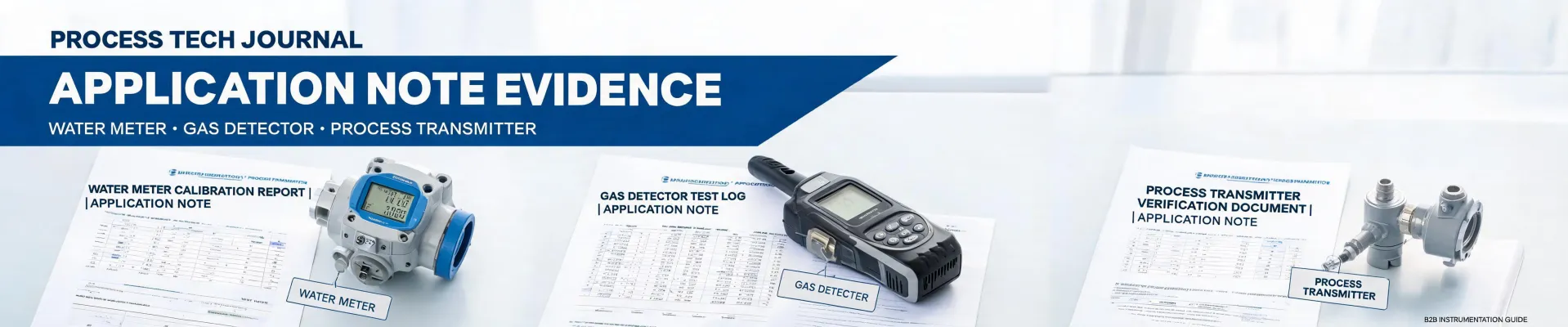
Why the Itron Intelis WSource Ultrasonic Water Meter Won Our Order: Delivery Certainty Beats a Cheap Quote
2026-09-04 by Marcus Feld
In utility procurement, I've stopped believing that the lowest bid is the best bid—not when a delivery date is attached to it. That can sound like an odd thing for a purchasing person to say. After five years of managing vendors for a water utility, though, I'm convinced: the actual premium in any equipment order is certainty.
My job covers a few million dollars a year in spending, from meter boxes and distribution valves to the analytical balance the water quality lab uses. There are 60-ish active vendors, plenty of internal customers, and a constant stream of deadlines. A late delivery doesn't just hit my budget. It hits the crew, the schedule, and in the worst cases, the people we supply.
The Order That Changed How I Buy
In 2024, we replaced 2,400 residential water meters by a hard date. The deadline was tied to a rate-case condition, which meant the board and the state regulator were both watching the calendar. We tested several AMI-ready ultrasonic meters. The two finalists were the Itron Intelis WSource ultrasonic water meter and a lower-priced alternative. Performance was close enough that procurement—meaning me—made the decision on price.
The cheaper vendor promised delivery in eight weeks. Itron gave us an eleven-week date and charged a premium for it—maybe 15% more, something like that. I remember thinking, why pay more to wait longer? I signed the cheaper one. I still cringe a little writing that. By week five, the order was in a production queue. By week seven, the ship date had slipped twice—first to twelve weeks, then to fourteen. We canceled, paid the restocking fee, and reordered from Itron.
The project still made its deadline, but the cheap route added real cost. Restocking fees, overtime, and an installation schedule squeezed from both ends. Don't hold me to the exact total—I would guess it landed near $60,000 once internal labor was included. Finance may still be calculating the frustration line item.
The Longer Date Was the More Certain One
The counterintuitive piece: I trusted Itron's longer lead time more than the shorter one from the other vendor. Not because of the logo on the box. Because Itron was willing to explain the production slot, commit to the date in writing, and accept a penalty if they missed it. That isn't a sales estimate. That's an operational plan.
There's a difference between a lead time and a guess. When a salesperson needs this month's number, 'eight weeks' rolls off the tongue easily. When a manufacturer actually has a production schedule, they will tell you the real date—even when it is less convenient. In a utility project, 'probably by the 15th' costs more than 'guaranteed by the 22nd.' The premium buys certainty. And certainty is what lets everyone else do their jobs.
Even the documentation told the story. The flow meter manual that came with the Itron Intelis WSource ultrasonic water meter was short enough to be useful—installation, wiring, verification, and troubleshooting in roughly 40 pages. The lower-priced vendor's manual read like a 180-page legal brief. I dismissed that difference during the evaluation. That was a mistake. Documentation is part of the product.
This Was Never Just About Meters
The same thinking applies to completely different purchases. This spring, the water quality lab needed a new analytical balance before an accreditation audit. One distributor quoted a lower price but could not guarantee the calibration certificate would arrive with the equipment. Another quoted about $300 more and gave us a delivery date plus the certificate in the box. We took the second one. Missing a calibration document during an audit creates findings, follow-up visits, and hours of staff time. That $300 was cheap.
Or take the FLIR vs Fluke thermal camera debate in our leak detection group. Full disclosure: Itron doesn't make thermal cameras, so no brand loyalty was involved. The specs were close, the prices were close, and my team was split. The tie-breaker was shipping certainty. Fluke's distributor confirmed inventory and a delivery week. FLIR's regional office said the camera was 'likely' available. 'Likely' doesn't work when you have a leak survey scheduled. We ordered Fluke. It doesn't mean FLIR builds a bad camera—it means the certainty wasn't there on that deal.
What About the Budget?
I can hear the objection: procurement exists to control costs, not to pay premiums. I agree with the first half. But the total cost of an order is the invoice plus the cost of a wrong date. If two weeks of idle installation crews costs more than the meter premium, the cheaper meter was never cheaper. You just pay the difference in a messier way.
The same principle applies to claims about performance. Under FTC advertising guidance, sellers should substantiate claims before they make them (ftc.gov). I'm not planning to file a complaint over a meter quote, but the idea is useful. When a supplier tells me their equipment will hold accuracy for two decades, I ask for the test data. When they promise a date, I ask how they'll hit it. If there's no evidence, the claim isn't a claim—it's a wish.
Predictability shouldn't feel like a luxury. Take the United States Postal Service as a boring example. It publishes its prices and delivery standards—a First-Class Mail letter costs $0.73 as of January 2025 (usps.com/stamps). When you drop a first-class envelope in the mail, you don't call the recipient every few hours with an updated guess. You both know when to expect it. That's the calm a utility buyer wants from a meter supplier: a clear price, a real date, and the capability to meet it.
So, five years in, here's my position. If a deadline matters, buy certainty first and price second. If a vendor won't commit to a date or can't explain how they'll meet it, their discount isn't a saving. It's a gamble.
Even now, when someone asks why an Itron ultrasonic water meter costs more than another option on a bid sheet, my answer isn't really about the hardware. It's about whether the delivery date is real. A meter that arrives when promised—and arrives with documentation a technician can actually use—is not a luxury. It's the product.
I'll take the honest eleven-week date over the fantasy eight-week one—every time.

Marcus Feld
Marcus Feld is an electrical test and measurement analyst specializing in multimeters, oscilloscopes, clamp meters, insulation testers, spectrum analyzers, and data loggers. He applies IEC 61010-2-030 and IEC 61010-031 concepts while examining measurement category, bandwidth, true-RMS response, input loading, and stated uncertainty. His work helps maintenance engineers and test teams choose safe instruments with performance suited to the signals and environments they actually measure.
Leave a Reply