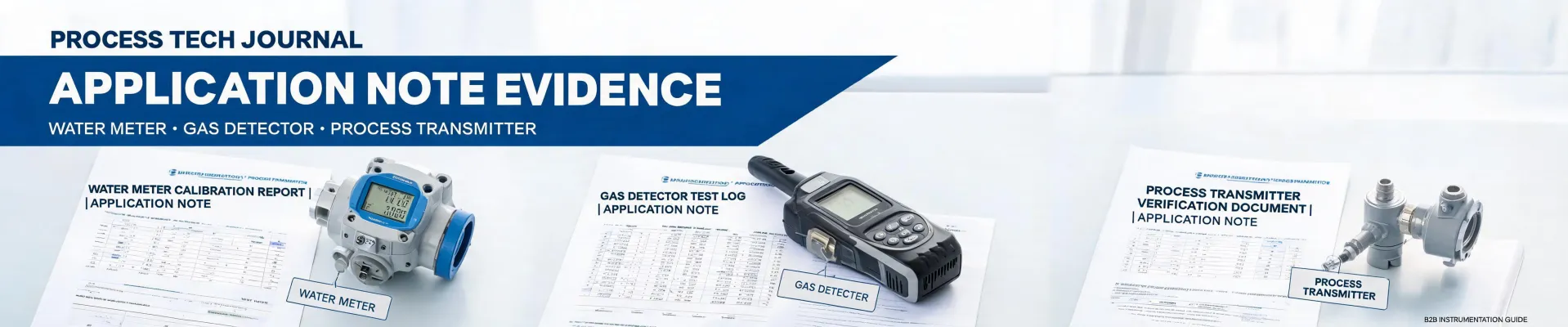
Quality Perception Starts With Your Instruments: Itron Water Meters, FLIR One Pro, and the ExStik PH100
2026-09-03 by Marcus Feld
Here’s a sentence that may cause a quiet argument in your next budget review: field tools are not technical equipment. They are customer-service equipment. In the first five minutes of an emergency response, a client can’t tell whether your data model is perfect. They can tell if your gear looks borrowed and inaccurate.
I’m a field response specialist for water and energy utilities. In my role coordinating emergency deployments for utility clients, I’ve processed hundreds of rush requests—same-day water quality checks, failed meter replacements, and after-hours inspections where the wrong answer would mean boiling water or a halted plant. Every one of those calls taught me the same lesson: quality perception is not a soft value. It drives revenue.
So here is my opinion, stated clearly: if you are choosing measurement tools based on the purchase price alone, you’re making a customer-experience decision without knowing it.
The meter in the ground is the brand in the ground
No one throws a parade for a water meter. But the meter is the first and last point of contact between a utility and its customers. It generates every billing decision, every leakage estimate, every conservation report. If the meter gets the numbers wrong, the utility carries that error, sometimes for decades.
That is why I’m blunt about Itron products. Itron water meters don’t promise to be the cheapest option on a bid tab. They are designed to keep measurement believable across a long service life. When a utility deploys Itron water meters, it is buying fewer surprises and fewer field arguments. In my job, that counts more than the discount.
I don’t have to sell anyone on a specific meter design. The standards do that. Most utility and AWWA-related meter requirements I’ve seen ask for accuracy within 1.5 percent at normal working flows. That is the bar. The equipment you install has to clear that bar, day after day, in cold water and hot summers. A meter that slips out of spec may not feel urgent. But in a district with thousands of connections, a 2 percent registration error becomes a revenue gap with a name.
A thermal camera makes invisible problems visible—and visible is what clients trust
In March 2024, I responded to a pumping station with a breaker that kept tripping. The plant electrician had spent two hours with a multimeter and was leaning toward replacing a panel that cost thousands of dollars. I arrived with an iPhone and a One Pro thermal imaging camera for iOS from FLIR. I set the emissivity to 0.95 for the painted enclosure, let the camera settle for about a minute, and scanned the breakers. One lug was noticeably hotter—maybe 15 degrees C hotter than the identical lugs around it, I didn’t record the exact number. That was the loose connection. We fixed it in twenty minutes.
That story is not really about thermal imaging technology. It is about what happened after the scan: the plant manager watched the problem appear on my phone screen. He didn’t have to trust my intuition. The evidence was glowing orange in the middle of a dark image. That is what quality perception feels like in B2B work.
The manual is full of specs, but here is the practical field version of how to use FLIR thermal camera controls. Pick the right emissivity value instead of using the default without thinking. Most painted electrical equipment is close to 0.95. Bare metal? That is more of a reflection problem than a temperature problem. Turn on MSX so the thermal image is blended with the visible camera edges, otherwise the client won’t know which breaker is the hot one. And wait for the sensor to stabilize before you make a judgment call. A thermal imager used quickly is as dangerous as a pH meter that is out of calibration.
One bad pH reading can erase a contract
Here’s a quieter example. A colleague—not me, but someone I supervised—took a budget pH tester to a school because tenants complained about metallic-tasting water. The tester showed a pH around 6.5, so he started telling the maintenance director they might need a corrosion treatment system. That was a serious conversation with a serious price tag.
I happened to be nearby with the PH100 ExStik pH meter from Extech. I’m not loyal to the brand because it’s expensive; I’m loyal because it calibrates in a few seconds and I trust the repeatability. When I dipped it into the same water sample, it read 7.7. The budget tester was reading a full point low because no one had checked its calibration before the call.
Let’s do the cost arithmetic. The budget tester saved maybe $80 compared with the ExStik. The proposed corrosion treatment would have cost the district around $12,000 if someone had approved it. The school called later to thank us for catching the error, but I could hear the doubt in the supervisor’s voice. What if we had scared the tenants with a false report? It took months to rebuild trust.
Was the more expensive meter worth it? Looking back, I should have implemented a calibration checklist before any emergency kit went into the field. At the time, I was trying not to micromanage my team. Now I do it anyway. I’d rather be annoying and accurate than liked and unreliable.
But what if we can’t afford the upper tier?
I’m not saying every utility needs every premium instrument. I’m saying the instrument should be able to do the job—and you should know when it can’t. There are field tasks where a simple disposable pH strip or a handheld IR thermometer is enough. The problem starts when those tools are used for decisions that affect public safety or six-figure repair costs.
If you are building a smart water network, Itron products are not a luxury. The communication infrastructure, the meter data platform, and the long-term accuracy are the service. If you are doing electrical troubleshooting, the One Pro thermal imaging camera for iOS is not a toy. It is a way to turn an invisible risk into a visual fact. And if you are advising a school district on water quality, the PH100 ExStik pH meter—or whatever calibrated pH meter you trust—is part of your professional ethics.
You can be the smartest specialist in the room and still lose the job if your measurement tools make you look careless. Quality perception starts before you open your mouth. It starts with the meter a utility installs, the thermal image you show, and the pH reading you are willing to defend.
I’d rather explain why a tool was worth the money than explain why a cheap reading caused a panic. In emergency field work, the tool in your hand is part of the message. Spend on it like it matters, because it does.

Marcus Feld
Marcus Feld is an electrical test and measurement analyst specializing in multimeters, oscilloscopes, clamp meters, insulation testers, spectrum analyzers, and data loggers. He applies IEC 61010-2-030 and IEC 61010-031 concepts while examining measurement category, bandwidth, true-RMS response, input loading, and stated uncertainty. His work helps maintenance engineers and test teams choose safe instruments with performance suited to the signals and environments they actually measure.
Leave a Reply