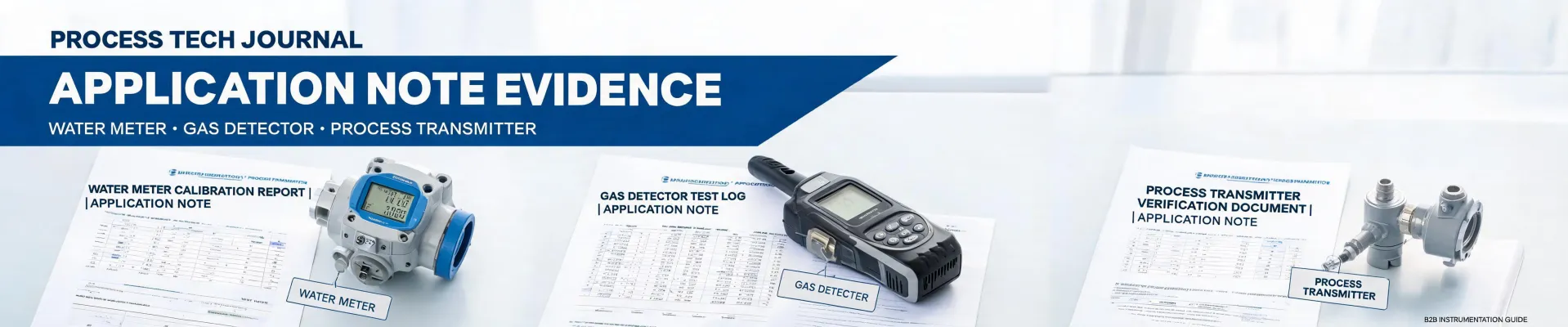
I've Learned This the Hard Way: 3 Things to Double-Check Before You Order an Itron Water Meter
2026-07-13 by Marcus Feld
If you are ordering an Itron meter, your single most important step isn't finding the best price—it's verifying the manual matches your application exactly. A model number mismatch cost my company a full week of rework and an extra $1,400 in rush shipping.
That is not an exaggeration. Our operations team needed a replacement Itron water meter for a high-volume commercial line. I found a great price from a new distributor, processed the order quickly, and hit 'submit' with a sense of efficiency. When the meter arrived, the installation team couldn't get it to communicate with our existing system. The 'Itron water meter manual' I had downloaded was for a different series. The pinouts were wrong. It was a mess.
Managing 60-80 orders a year for our facility, I've learned that for technical equipment like Itron flow meters and measuring instruments, the purchase process is not just about the price tag. (Ugh.) It's about the documentation, the hidden costs, and the tools you already own.
1. The Manual is the Real Contract (Not the Price)
It's tempting to think: 'It's an Itron water meter, how different can they be?' But the 'One standard meter' advice ignores the nuance of firmware versions, communication protocols, and installation requirements. I now treat the Itron water meter manual as the single source of truth.
When I compared our existing meter's manual with the one for the model I ordered—side by side—I finally understood why the details matter so much. The replacement was a newer model, but it required a different power supply module. The vendor's listing just said 'compatible,' which was... not entirely false, but definitely not plug-and-play.
The Mistake I Made
I assumed 'Itron' was enough. I didn't download and cross-reference the specific model's manual until after the meter arrived. That was a failure of process, not of price. Now, I have a checklist that includes:
- Download the PDF manual from the official Itron portal (verify it matches the model number on the invoice).
- Check release date on the manual. (This was true of the original spec, but revision 3.2 changed the wiring diagram. That matters.)
- Send the manual to our field ops lead for sign-off before the PO is approved.
A 15-minute manual check would have saved us 5 days of rework. Seriously.
2. Your Existing Tooling Matters More Than You Think
This is where a lot of admin buyers get tripped up. We compare specs, we compare prices, but we rarely compare the tools required to maintain the equipment. Our team had a specific set of measuring instruments for calibration. I ordered a flow meter that required a specialized centrifuge for a pre-installation test we didn't even know was necessary.
It's a bit like the old debate of Starrett vs Mitutoyo digital calipers. Both are excellent. But if your entire workshop is set up with Mitutoyo data output cables and software, swapping to Starrett means a hidden investment in adapters and training. Its not about which is 'better,' its about which integrates without friction.
When I ordered the new flow meter, I didn't ask our maintenance team if our existing calibration measuring instruments could handle the new spec. They couldn't. The 'savings' I got on the meter was immediately wiped out by the rental cost of the correct centrifuge and the technician's overtime.
5 minutes of verification beats 5 days of correction. Always check the compatibility of your ancillary equipment and calibration tools before signing the PO.
3. The Total Cost of Ownership is the Only Real Price
That cheap Itron water meter I found? It didn't include the communication module. It was 'base model' pricing. I discovered this when our tech went to install it. The line-item cost was great; the total installed cost was not. It made me look bad to my VP (whoops).
The total cost of ownership includes:
- Base product price (the one you see on the quote).
- Required accessories (modules, brackets, cables).
- Shipping and rush fees (if needed).
- Tooling or calibration costs (like that centrifuge rental).
- Potential rework costs (if the manual was wrong).
Pricing is for general reference only; actual prices vary by vendor and spec (as of our January 2025 audit). The lowest quoted price is almost never the lowest total cost.
A Note on Calibration Tools (The Starrett vs Mitutoyo Angle)
Just like the Starrett vs Mitutoyo digital calipers decision, the right choice for your facility depends on your existing ecosystem. Don't make the decision in a vacuum. If you are upgrading your measuring instruments, the most expensive option isn't always the best, and the cheapest is rarely the most cost-effective. Think about training, replacement parts, and software compatibility.
I've been managing this purchasing for a few years now (since 2021 roughly), and I can tell you that the cost of a 'bad' order isn't just the money—it's the trust you lose with your ops team and the time you spend fixing it. Prevention is everything.
So, before you click 'order' on that Itron flow meter, check the manual, check your tools, and check the total cost. Your team will thank you. (Finally.)

Marcus Feld
Marcus Feld is an electrical test and measurement analyst specializing in multimeters, oscilloscopes, clamp meters, insulation testers, spectrum analyzers, and data loggers. He applies IEC 61010-2-030 and IEC 61010-031 concepts while examining measurement category, bandwidth, true-RMS response, input loading, and stated uncertainty. His work helps maintenance engineers and test teams choose safe instruments with performance suited to the signals and environments they actually measure.
Leave a Reply